Auto finance is a managed DeFi liquidity strategy for hands-free LP yield
Auto finance is a DeFi liquidity management service built around automated yield farming and managed LP positions. It focuses on the work that makes liquidity provision demanding: placing assets into liquidity pools, harvesting protocol rewards, reallocating capital, and keeping positions aligned with changing market conditions. The service is best understood as an automation layer for people who want exposure to LP yield without manually babysitting every range, farm, reward claim, and rebalance.
The appeal comes from a simple problem in decentralized finance. Liquidity provision pays trading fees and incentive rewards, but those returns require active maintenance. A position that starts well can drift as prices move, rewards change, or a pool becomes less efficient. Auto finance packages that maintenance into managed strategies so the user interacts with a higher-level position rather than a stack of repeated DeFi tasks.
Managed LP positions are the core product
A liquidity provider position is a commitment of assets to an automated market maker pool. In return, the position earns a share of trading fees and, where available, protocol incentives. The challenge is that LP yield is dynamic. Pool volume, asset volatility, reward emissions, and price movement all affect the final return.
With Auto finance, the managed position is the product. The service runs the operational loop: deploy capital into supported strategies, monitor pool conditions, collect rewards, compound when that improves the position, and adjust allocations when the strategy calls for it. That does not remove market risk, but it does remove much of the manual timing and transaction management that turns LP farming into a daily chore.
How automated yield farming changes the user workflow
Traditional yield farming pushes the user through many small decisions. They choose a pool, approve tokens, add liquidity, stake the LP token if a farm exists, return to claim rewards, swap or compound those rewards, and decide when the position no longer deserves capital. Each step creates room for missed rewards, poor timing, or excessive transaction costs.
Automation turns that sequence into a strategy workflow. A user reviews the available strategy, deposits the required assets, and tracks the position as the system executes the routine operations. Auto finance is useful when the desired exposure is clear but the user does not want to manually operate every farm, incentive program, and rebalancing step.
Where yield comes from inside a liquidity strategy
Yield in this kind of service comes from real on-chain activity rather than a fixed interest schedule. Trading fees accrue when other users swap through the underlying pool. Reward tokens accrue when a protocol or ecosystem pays incentives to attract liquidity. Compounding adds harvested value back into the strategy so the active position grows instead of leaving idle rewards aside.
The strongest strategies combine fee generation, disciplined reward handling, and thoughtful allocation. A pool with high advertised incentives still performs poorly if price movement overwhelms fees, if rewards lose value quickly, or if the position sits outside an efficient range. The managed approach matters because the work is continuous, not a one-time deposit decision.
What a new deposit actually represents
Depositing into an automated LP strategy means the user is taking exposure to the assets inside that strategy and to the mechanics of the pool itself. If the strategy uses a pair such as a stablecoin and a volatile token, the position behaves differently from a stablecoin-only pool. If the strategy compounds rewards into the same pool, the balance of assets changes as trading and harvesting continue.
Before depositing, users should understand four practical details:
- which assets the strategy holds after the deposit is complete;
- how rewards are harvested, swapped, or compounded;
- whether the position relies on concentrated liquidity, standard AMM liquidity, or a staking layer;
- how withdrawals return assets when pool prices have moved;
- which network fees apply when entering, exiting, or claiming.
That checklist keeps the focus on the position's economic behavior rather than only on the displayed yield figure.
Rebalancing is the difference between passive and managed LP exposure
Rebalancing is one of the main reasons to use a liquidity manager. In concentrated liquidity designs, capital earns most efficiently when it sits inside a price range where trading happens. If the market moves away from that range, the position stops earning the intended fees until it is adjusted. Even in broader pool designs, capital allocation still changes as token prices move.
More broadly, Auto finance addresses that operational burden by treating rebalancing as part of the strategy. The protocol logic or manager process decides when a position needs adjustment, then moves capital according to the strategy rules. The user still owns the economic exposure of the position, including impermanent loss, but the ongoing pool maintenance is handled through the service.
Benefits for users who already understand DeFi risk
The clearest benefit is time saved. A managed strategy removes repeated harvest, compound, and rebalance work from the user's routine. It also creates a more organized way to follow LP exposure, because performance is tied to a named strategy instead of a loose collection of pool tokens, farm receipts, and unclaimed rewards.
Another advantage is consistency. Manual farmers drift from their own plans when gas costs rise, rewards pile up, or a position looks fine at a glance. Auto finance applies the same process across the strategy lifecycle, which matters in markets where yield opportunities change quickly and small missed actions stack up over time.
Risks that matter before entering a strategy
The central risk is that LP positions do not behave like simple token holdings. Impermanent loss appears when the pool's asset prices diverge, and a high fee period does not always offset that change. Smart contract risk also matters because deposits interact with strategy contracts, token approvals, AMM pools, and reward systems.
One specific caution deserves attention: withdrawals return the position according to the pool state at exit, so the assets received can differ from the starting mix. That is normal for LP strategies, but it surprises users who expect the same token balance they deposited. Reading the strategy composition before entry is the cleanest way to avoid that mismatch.
When this service fits better than manual farming
Manual farming suits users who enjoy moving between protocols, tuning ranges, and making frequent allocation decisions. A managed LP service fits users who already want liquidity exposure and prefer a systematized process for the repetitive work. It is especially relevant when a strategy needs compounding and rebalancing to stay competitive.
Day to day, Auto finance also fits users who compare DeFi yield opportunities by operating model rather than headline return. The useful question is whether the service handles the tasks that drive realized performance: efficient deployment, reward handling, reinvestment, range management, and clean exits. If those tasks are the burden, automation has a direct purpose.
Alternatives in the same DeFi toolkit
Several neighboring options solve different problems. A user who wants full control can provide liquidity directly through an AMM such as Uniswap, Curve, or Balancer and manage every action independently. A user who wants simpler lending exposure can supply assets to a lending market such as Aave or Compound, where returns come from borrower demand rather than LP trading fees. Vault products and yield aggregators offer another route by bundling compounding and allocation into strategy shares.
The right alternative depends on what the user wants to own. Direct AMM liquidity gives maximum control and maximum operational work. Lending markets offer cleaner single-asset exposure with different rate dynamics. Auto finance belongs in the managed LP category, where the goal is to keep liquidity positions productive while reducing the hands-on work of farming.
Reading the dashboard like an LP manager
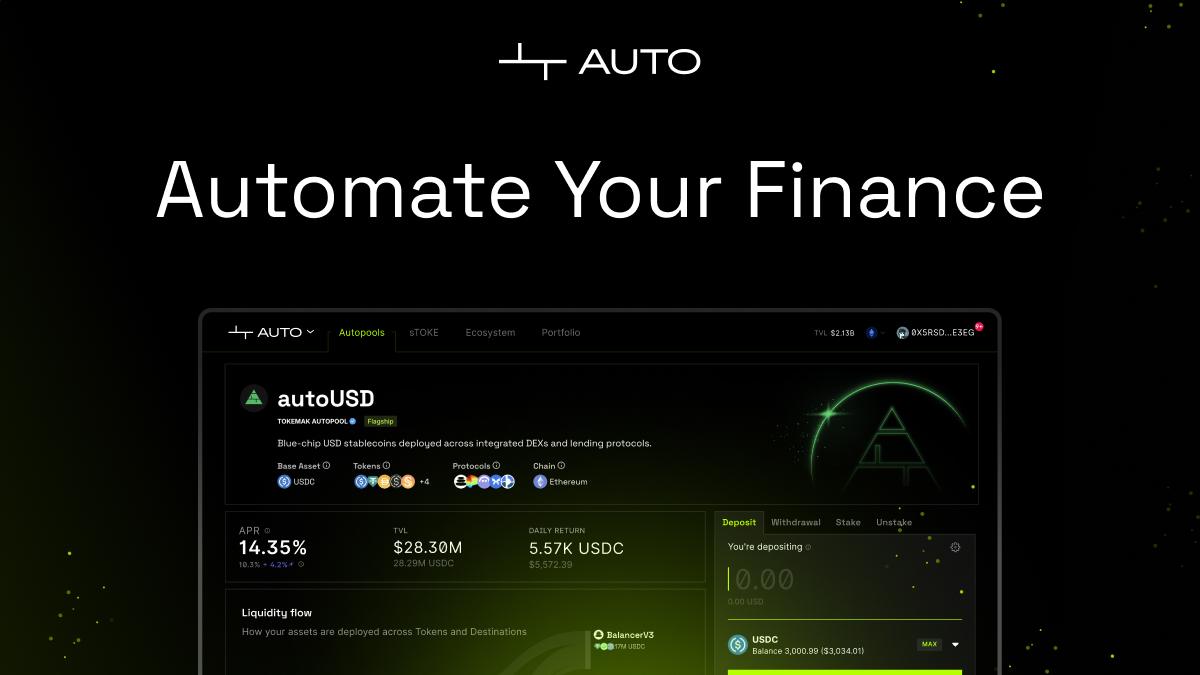
A good dashboard view should make the position understandable without forcing the user to reconstruct every on-chain step. The important fields are deposited assets, current value, earned rewards, allocation status, fees, and withdrawal path. Those items explain what the strategy is doing today and what the user receives when leaving.
Performance should be read over time, with attention to the underlying asset movement. A strategy that earns fees while one asset falls sharply can still show a weaker result than holding the assets separately. That is not a failure of automation; it is the nature of LP exposure. The service gives structure to the process, while the market determines the economic outcome.
Auto finance questions worth asking
- Does Auto finance custody my tokens during yield farming?
- A managed LP strategy uses smart contracts to hold and operate the deposited position according to its rules. That means the assets leave the user's wallet and enter the strategy contract until withdrawal. The user interacts through wallet approvals and transactions, while the position remains exposed to the contract logic, the underlying liquidity pool, and the reward mechanisms connected to the strategy.
- Fees on Auto finance managed positions: what costs should users expect?
- Costs come from several places: network gas, token swaps used during deposit or compounding, AMM trading fees inside the pool, and any strategy-level fee disclosed by the service. The visible yield is only part of the picture because small positions are more sensitive to gas and routing costs. Larger or longer-held positions absorb routine compounding costs more efficiently.
- Can I withdraw from an automated LP position at any time?
- Withdrawals depend on the strategy contract and the liquidity available in the underlying pool. In a standard LP strategy, exiting returns the current value of the managed position after the pool math, fees, and any required unwinding steps. The returned token mix can differ from the original deposit because AMM positions rebalance economically as prices move.
- Why does my LP position value change when rewards are accruing?
- Rewards are only one component of LP performance. The position value also changes with the prices of the pooled assets, impermanent loss, trading-fee income, compounding transactions, and any reward token price movement. A position can collect incentives while its total value falls if the underlying asset move is larger than the earned fees and rewards.
- Is a lending market a simpler alternative to Auto finance?
- A lending market is simpler when the goal is single-asset yield from borrower demand. It does not create the same AMM exposure or impermanent loss profile as an LP strategy. The tradeoff is that lending rates follow utilization, while managed liquidity strategies pursue trading fees, rewards, and compounding. The better fit depends on whether the user wants loan-market yield or liquidity-provider exposure.