Auto finance is automated LP management for DeFi yield farming
Auto finance is an automated liquidity management service for DeFi users who want hands-free LP strategies across major protocols. It organizes the work of placing liquidity, tracking pool conditions, and adjusting positions so yield farming becomes a managed workflow rather than a constant manual routine. The core value is automation around liquidity provider activity, with smart contracts and strategy logic handling operational steps for each position.
The service belongs to the same broad category as yield optimizers, vault systems, and automated market maker management tools. A user deposits supported assets into a strategy, and the strategy follows predefined rules for where liquidity is deployed, how positions are maintained, and when rewards or fees are folded back into the position. That makes Auto finance most relevant to people who already understand DeFi wallets, token approvals, liquidity pools, and smart contract execution.
Hands-free LP strategies explained through the vault flow
A hands-free LP strategy starts with a deposit into a managed contract. The contract receives the user's assets, routes them into a liquidity position, and records the user's share of that strategy. From that point, the portfolio logic handles the repeated tasks that active liquidity providers normally perform by hand: monitoring pool ranges, accounting for earned fees, harvesting protocol incentives, and keeping capital assigned to the intended market.
Auto finance uses this model to turn liquidity provision into a structured process. The user still chooses the broad exposure by selecting a strategy and assets, while the operational layer performs the ongoing LP maintenance. This matters because DeFi liquidity farming rewards attention. Pool fees, token emissions, and price movement all change the economics of a position, and automation reduces the need to sit in front of a dashboard all day.
Where yield optimization enters the liquidity cycle
Yield optimization is the part of the workflow that decides how value generated by a position gets handled. A basic LP position earns trading fees from an automated market maker. Some pools also distribute incentives in governance tokens or reward tokens. A managed strategy collects those outputs and applies a rule set: compound them, rebalance the position, or keep them ready for withdrawal according to the strategy design.
The important point is that the optimizer works on real DeFi mechanics rather than a fixed interest schedule. Returns come from pool activity, incentives, and market structure. When token prices move sharply, a liquidity position changes shape because the pool trades one asset into the other. That is why strategy design matters as much as the headline annual percentage shown in an interface.
What liquidity providers use it for
More broadly, Auto finance fits users who want exposure to liquidity pool yield without managing every adjustment themselves. It is especially useful when a position requires recurring actions, such as claiming rewards, redeploying earned tokens, or watching whether liquidity remains productive. The service packages those actions into strategy logic so the user interacts with the strategy rather than each pool operation separately.
- Running LP positions with less manual claiming and redeployment.
- Using automated compounding to keep earned value working.
- Organizing yield farming positions through strategy-level accounting.
- Reducing idle rewards that sit outside the active liquidity position.
- Following predefined liquidity rules instead of improvising each adjustment.
This does not turn DeFi yield into a passive cash account. It remains an on-chain strategy exposed to smart contract behavior, market depth, token volatility, and the rules of the underlying pools. The benefit is workflow efficiency and disciplined execution, not removal of risk.
Smart contracts, approvals, and position ownership
Every automated DeFi system depends on wallet permissions. Before using a strategy, a wallet signs token approvals that allow the contract to move the selected assets for that strategy. Once deposited, the position is represented through the platform's accounting rather than a manually held LP token in the wallet. Withdrawals then unwind the user's share according to the assets and liquidity available in the strategy.
That structure makes contract review and permission hygiene important. Users should understand which tokens they approve, what amount is being approved, and which wallet is connected. Auto finance automates the strategy side, but the wallet remains the control point for deposits, withdrawals, signatures, and transaction fees.
Costs that shape the real return
LP returns are shaped by more than rewards. Network gas fees affect deposits, withdrawals, harvesting, and strategy maintenance. Pool fees add income when traders use the market. Incentive emissions add another layer when a protocol pays rewards to attract liquidity. Impermanent loss changes the value of the position relative to holding the tokens separately when prices diverge.
Day to day, Auto finance is best evaluated by looking at the entire cost stack: gas, vault or strategy fees if shown in the interface, swap slippage during position changes, and the economics of the underlying pool. A high-yield pool with thin liquidity or unstable token prices creates a different profile from a deep pool with steadier trading demand. The clearest evaluation compares the strategy's behavior with a realistic manual LP alternative.
Getting started with a DeFi wallet and supported assets
A new user begins with a self-custody wallet, the assets required by the selected strategy, and enough native gas token to pay network transactions. The workflow normally moves from connecting the wallet to selecting a strategy, reviewing the asset pair, approving token access, depositing, and tracking the position after confirmation. Each transaction appears in the wallet before it reaches the chain.
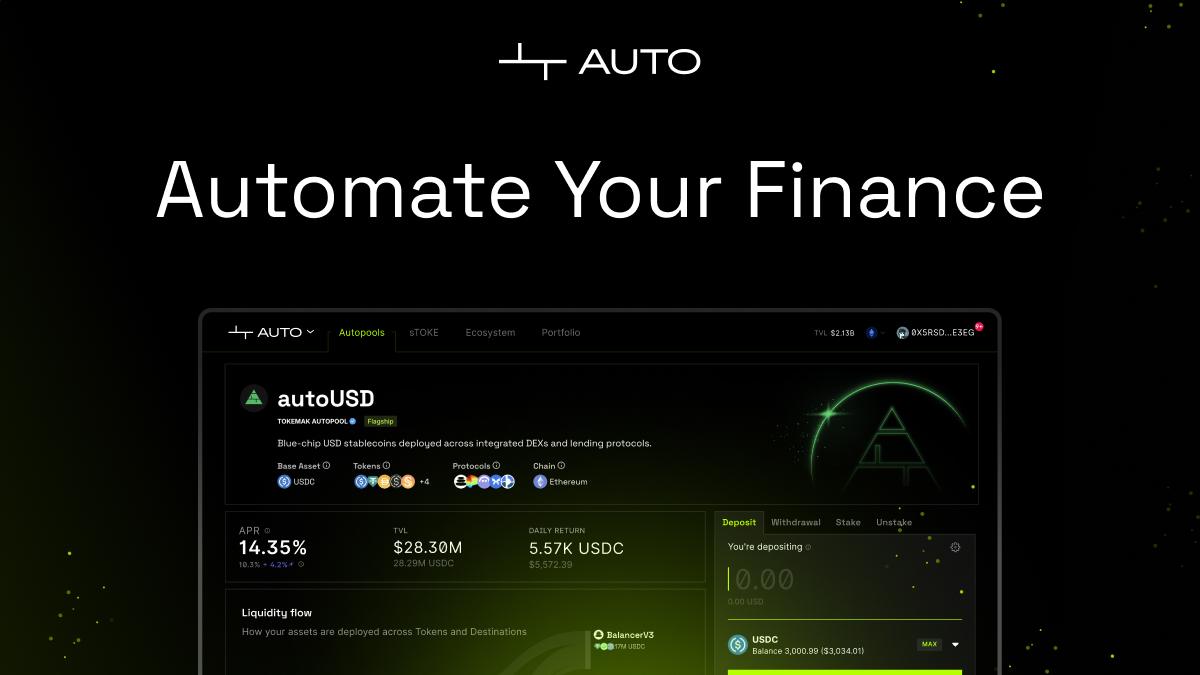
The cleanest first deposit is small enough to understand the flow while still covering network costs sensibly. After the position is live, the dashboard view becomes the place to watch deposited value, rewards, compounding behavior, and withdrawal options. Auto finance makes the day-to-day LP routine lighter, but initial setup still rewards patience because token approvals and deposits are separate on-chain actions.
Benefits for active DeFi yield farmers
Active yield farmers care about execution rhythm. Missed claims, idle rewards, and delayed redeployment all reduce realized performance over time. Automated liquidity management creates a rule-based routine that acts consistently as long as the strategy remains active and the underlying markets support it. That consistency is the main advantage over a spreadsheet-driven manual process.
It also improves portfolio organization. Rather than tracking every pool action as a separate task, the user watches the strategy as a single position with visible deposits and outputs. Auto finance therefore works like an operations layer for LP farming: it does not change the economic laws of AMMs, but it gives the farming process a repeatable structure.
Risks tied to AMMs and automated strategies
LP automation concentrates several DeFi risks into one workflow. Smart contract bugs affect the vault layer. Oracle or pricing assumptions, when used by a strategy, affect execution. Pool volatility creates impermanent loss. Reward tokens lose value when emissions outpace demand. Liquidity can also become expensive to exit during stressed market conditions.
The practical caution is to match strategy size with risk tolerance and understand the pool behind the yield. A stablecoin pair behaves very differently from a volatile token pair, and a mature AMM market behaves differently from a new incentivized pool. Auto finance improves process discipline, but market movement still decides much of the final outcome.
Manual LP management, vault optimizers, and aggregator routes
Alternatives sit along a spectrum. Manual LP management on an AMM gives the user direct control over every deposit, reward claim, and withdrawal. Vault optimizers such as Yearn-style systems emphasize pooled strategy execution and compounding. Aggregator routes focus on finding efficient swaps or paths, then leave the longer-term LP position to the user or another tool.
Importantly, Auto finance is closest to the automated liquidity manager category because its purpose is ongoing LP strategy operation rather than one-time trade routing. Users who want complete control stay closer to manual AMM positions. Users who want strategy-level execution choose a vault or automation layer. The right fit depends on whether the main problem is trading, lending, or managing liquidity over time.
How to judge whether a strategy is working
A productive strategy shows more than a changing balance. Review the asset pair, pool depth, reward source, compounding activity, withdrawal path, and the difference between token-denominated returns and dollar-denominated returns. Those details explain whether gains came from trading fees, incentives, price appreciation, or a mix of all three.
In practice, Auto finance should be judged by execution quality: whether rewards are handled efficiently, whether liquidity remains assigned to the intended market, and whether the strategy's realized performance beats the effort and cost of doing the same actions manually. That is the standard that matters for an automated DeFi yield farming service.
Auto finance: questions and answers
- What assets do users need before using Auto finance?
- A user needs a compatible self-custody wallet, the tokens required by the selected liquidity strategy, and enough native gas token to pay transaction fees on the relevant network. The exact deposit assets come from the chosen LP strategy, because different pools use different token pairs. Token approvals and the deposit transaction happen from the connected wallet before the position becomes active.
- Does automated compounding remove impermanent loss?
- Automated compounding does not remove impermanent loss. It handles rewards and redeployment according to strategy rules, while the underlying liquidity position still reacts to price movement between the paired assets. If one asset rises or falls sharply against the other, the pool balance changes. Compounding improves operational efficiency, but AMM exposure remains part of the position.
- How long does a withdrawal take from an LP strategy?
- Withdrawal timing depends on the network, the strategy contract, and the liquidity conditions of the underlying pool. A normal withdrawal requires an on-chain transaction and confirmation in the connected wallet. If the strategy needs to unwind liquidity or convert reward assets, the process involves additional contract steps. The user should expect blockchain confirmation time rather than instant off-chain settlement.
- Can beginners use Auto finance without knowing DeFi?
- Beginners can follow the interface, but they should understand wallet signatures, token approvals, gas fees, LP positions, and smart contract risk before depositing meaningful funds. The service simplifies ongoing management, yet it still uses real DeFi infrastructure. A small first deposit helps a new user learn the sequence of approvals, deposits, position tracking, and withdrawals.
- Which risks matter most for automated liquidity strategies?
- The main risks are smart contract failure, impermanent loss, reward token volatility, pool liquidity changes, and transaction costs during deposits or withdrawals. Strategy automation adds convenience, but it also means a contract is making repeated operational decisions. The pool composition and asset quality matter as much as the displayed yield because those inputs drive the final value of the position.
- Is Auto finance closer to a yield vault or a swap aggregator?
- It is closer to a yield vault and liquidity manager than a swap aggregator. A swap aggregator focuses on routing a trade at a given moment. This service focuses on maintaining LP strategies over time, including reward handling and liquidity management. The user's main interaction is with a strategy position rather than a single token exchange.