Auto finance is an automated liquidity router for DeFi LP yield
Auto finance is an automated DeFi yield farming and liquidity management service built for people who want LP positions managed without constant pool-hopping. It routes liquidity across supported decentralized finance opportunities, watches yield conditions, and applies hands-free strategies around pool selection, compounding, and position maintenance. The core idea is simple: put capital into a strategy, let automation handle the operational work, and judge the position by net yield, risk exposure, and wallet-level control.
The finance angle matters because LP yield is less like a fixed coupon and more like an active market position. Rewards, trading fees, incentives, token prices, and pool depth all move at the same time. A yield manager that tracks those inputs gives users a cleaner way to approach DeFi returns than checking dashboards manually and moving funds every time incentives change.
Automated liquidity routing, not passive yield farming
Yield farming starts with supplying assets to a pool, vault, or strategy that earns fees and incentives. The harder part is deciding when a position has stopped being attractive. Auto finance focuses on that decision layer: routing liquidity toward better opportunities across major DeFi venues instead of leaving the user to compare every pool by hand.
That routing layer looks at the economic shape of a position. A high reward token emission means little when the paired asset is volatile, liquidity is thin, or trading fees fail to offset impermanent loss. Stronger strategies account for pool depth, fee generation, reward durability, compounding cadence, and the cost of moving capital.
Where LP strategies fit in a DeFi portfolio
LP strategies sit between simple token holding and more complex leveraged farming. The user provides assets to liquidity pools used by decentralized exchanges and other DeFi applications. In return, the position earns a share of trading fees and receives incentive tokens when a protocol sponsors rewards for that pool.
Auto finance is useful when the goal is to make that process less manual. A wallet owner still chooses the assets and accepts the exposure, but automation handles repetitive tasks such as harvesting, reinvesting, and reallocating within the strategy rules. That turns LP management into a monitored allocation rather than a daily chore.
The mechanics behind hands-free compounding
Compounding converts earned fees or incentive tokens back into productive liquidity. In a manual setup, the user claims rewards, swaps tokens if needed, adds the correct pool ratio, and pays network costs for each transaction. An automated strategy batches or schedules those actions so the position keeps working with less idle reward balance.
The best use case is a pool where earned yield remains meaningful after swap costs, smart contract fees, and chain transaction costs. Small balances suffer when compounding happens too frequently, while larger positions lose efficiency when rewards sit unused for too long. Auto finance addresses that timing problem through strategy logic rather than guesswork.
What users should examine before depositing
Before committing funds, a user should understand the assets inside the selected pool and the source of yield. A position backed by active trading fees behaves differently from one funded mostly by temporary token incentives. The same displayed annual percentage changes character when rewards come from emissions rather than organic swap volume.
- Pool assets and their price relationship
- Trading fee share versus incentive rewards
- Expected rebalancing or compounding behavior
- Withdrawal process and any lockup terms
- Smart contract exposure across the chosen strategy
One specific caution deserves attention: impermanent loss rises when paired assets diverge sharply, so a strong headline yield still loses value if the pool mix moves against the original deposit.
Getting started with a wallet and a strategy
A typical onboarding flow begins with a self-custody wallet, supported assets, and enough native gas token to approve and deposit. The user connects a wallet, reviews available strategies, selects the pool or vault that matches the desired exposure, approves token access, and deposits into the chosen strategy.
After deposit, the dashboard becomes the main operating surface. It shows the active position, earned rewards, current value, and available actions such as adding liquidity, withdrawing, or changing exposure. Auto finance makes the most sense when the user returns to monitor performance at set intervals instead of reacting to every market tick.
Yield sources that matter more than a displayed APR
DeFi dashboards compress several moving parts into a single yield figure. Trading fees come from real swap activity. Incentives come from token emissions. Compounding adds efficiency by redeploying earned value. Rebalancing protects a strategy from drifting too far from its intended allocation.
The mix of those sources defines the quality of a position. A pool with steady volume and moderate rewards gives a different risk profile than a pool with low volume and aggressive emissions. Auto finance should be evaluated by the way it handles those inputs, not by a snapshot return number taken at one moment.
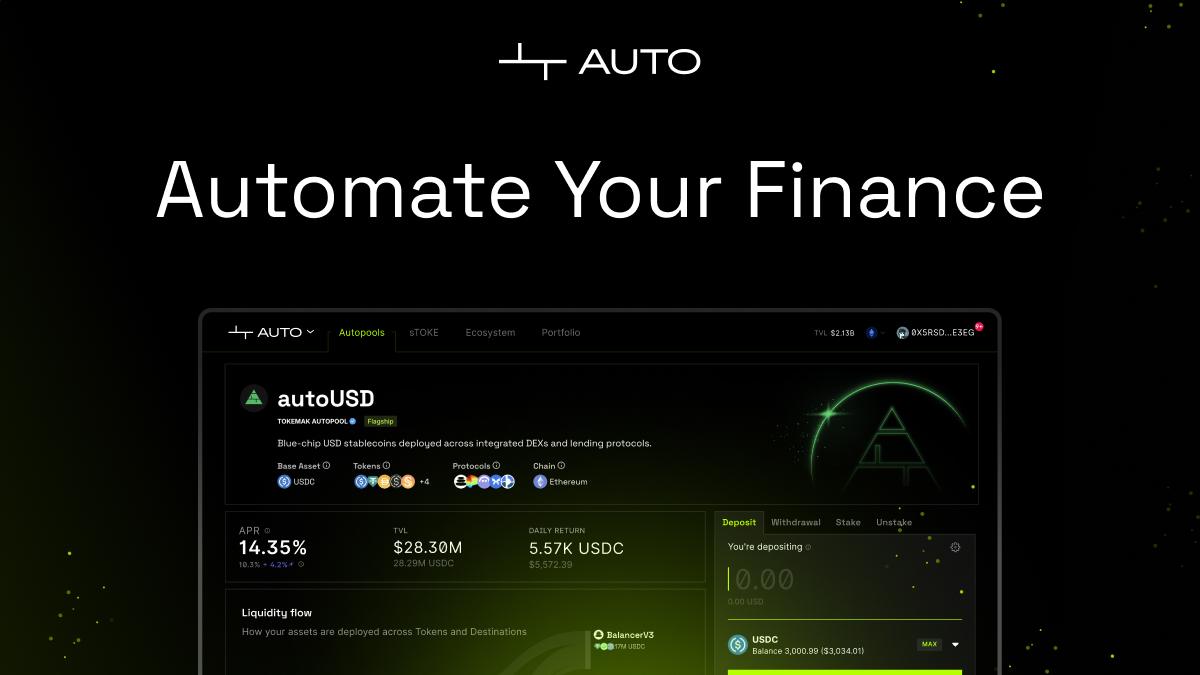
How automated routing changes the user workload
Manual LP management requires repeated small decisions: which pool to enter, when to harvest, whether rewards justify a swap, and when a position has become stale. Automation replaces that series of operational decisions with a strategy framework. The user spends more time choosing exposure and less time performing routine transactions.
This matters most when yield opportunities rotate quickly. Incentive programs launch, liquidity migrates, and fee levels shift as trading activity changes. Auto finance gives the user a structured way to participate in that rotation without building a personal spreadsheet for every decentralized exchange and vault.
Alternatives to automated LP management
The simplest alternative is holding tokens directly in a wallet. That avoids LP complexity but gives up trading-fee income. Another path is using a single-protocol vault, where the strategy stays inside one DeFi ecosystem. That approach narrows the moving parts while limiting the range of opportunities.
Advanced users sometimes manage LP positions manually through decentralized exchanges and portfolio trackers. They gain full tactical control, yet they also take on claiming, swapping, pairing, compounding, and rebalancing work. Auto finance is positioned for users who prefer strategy-level control over transaction-by-transaction management.
Who benefits from this kind of DeFi automation
The strongest fit is a user who already understands wallet approvals, pool exposure, and token volatility, then wants a cleaner operating model for liquidity positions. It also fits teams or treasury operators that track DeFi allocations and need consistent execution rules around compounding and pool rotation.
Newer users should begin with the mechanics before chasing yield. Reading the pool composition, understanding how LP tokens represent a claim on pooled assets, and checking withdrawal behavior creates a better base for using Auto finance responsibly. Once those pieces are clear, automation becomes a tool for execution rather than a substitute for understanding.
What to know about Auto finance
- What costs affect an Auto finance LP position?
- The main costs are network gas, token approval transactions, swap costs during compounding, and any strategy-level fee shown before deposit. The visible yield number should be read after considering those costs because frequent harvesting and rebalancing reduce smaller positions more than larger ones. Pool composition also matters because impermanent loss changes the position value even when rewards accrue.
- Do I need two tokens to use Auto finance liquidity strategies?
- Most LP positions require exposure to a token pair because decentralized exchange pools hold two assets in a defined relationship. Some strategy interfaces simplify the deposit path by balancing assets during entry, but the economic exposure still comes from the underlying pool. Users should review the final pool assets before approving a deposit.
- Which wallets fit an Auto finance workflow?
- A self-custody wallet that supports the relevant DeFi network and token approvals fits this workflow. The wallet must hold the deposit assets and the chain's native gas token for approvals, deposits, and withdrawals. Hardware wallets add a separate signing device, which suits users who want stronger key separation for larger DeFi positions.
- What happens if a pool used by Auto finance loses liquidity?
- Lower pool liquidity makes swaps less efficient and changes the risk profile of the LP position. A strategy that routes or reallocates liquidity should respond by favoring healthier pools when its rules support that move. The user still carries exposure to the assets already deposited until the position is withdrawn or shifted.
- Can Auto finance be used for stablecoin liquidity only?
- Stablecoin pools are a common choice for users who want lower price-divergence exposure than volatile token pairs. They still carry smart contract risk, depeg risk, and fee variability. A stablecoin-focused strategy should be judged by the specific assets in the pool, the depth of liquidity, and the yield source behind the return.